Showing posts with label Rabbit. Show all posts

Wednesday, September 4, 2013

Rabbit Rage

While they look cute and innocent some rabbits have been known to become aggressive.

 Picture from Wikipedia

When they feel threatened rabbits can become aggressive and grunt, lunge or even bite.  However they do not bite hard enough to break the skin, just hard enough to startle the individual.  With the proper behavioral tools, one can train their rabbit not to behave in such a manner.

Friday, October 14, 2011

Hares & Jackrabbits

Many people are not aware that jackrabbits and hares are from a different genus than rabbits. Though their long ears and body appearance is similar, jackrabbits and hares usually have longer, more slender bodies and more powerful legs.
All hares and jackrabbits are members of the Lepus genus; most North and South American varieties are referred to as jackrabbits, with hare being the common name in the rest of the world.

Whereas most rabbits live and give birth in underground burrows, jackrabbits and hares nest in simple shallow depressions above-ground. They give birth to fully furred young that are able to survive on their own at a very young age.
There are 32 species of hares and jackrabbits with numerous subspecies of most. They can be found in a variety of habitats from hot deserts to forested mountain regions. Like rabbits, hares eat a large variety of plants, shrubs, grasses and small trees. All members of the Lepus genus play an important role in their respective ecosystems as a food source. For instance, the black-tailed jackrabbit, common to most of western North America, is the primary prey of bobcats, coyotes, foxes and large raptors.

Not that hunting the jackrabbit is an easy task; some can run at speeds of over 45 miles per hour!

Wednesday, June 8, 2011

How Animals Keep Their Cool

Now that summer’s here, a lot of us probably plan on spending our free time at the pool. When it’s hot outside, nothing’s better than jumping into some nice, cool water to relax. But, when a/c or an ice-cold dip isn’t an option, our bodies still find a way to keep us cool; we sweat. Animals in the wild don’t have the option to crank up the air conditioner when they get too hot, so they’ve developed their own ways to cool down.
Photo: CoolFox
Now, we all know that dogs will pant when they get hot, as their tongues are very effective at releasing heat from their bodies, but did you know they also sweat from their feet? Dogs don’t have a lot of sweat glands like we do, but if overheated they can sweat from between their toes. Other mammals such as squirrels sweat in this same way. Cows can sweat from their muzzles, and rabbits sweat from their lips, though neither nearly as much as humans. Birds have no sweat glands at all, so they will flare their feathers and open their mouths in hot weather to increase their surface area and evaporate water from the surface of their bodies.

Photo: Rene Modery
 Have you ever heard the phrase “sweating like a pig”? Well, that’s not really possible, because pigs don’t sweat at all. To regulate their body temperatures, pigs have to roll in mud or water, which draws the heat from their bodies. They look like a mess, but they’re just trying to stay cool!

Photo: Andrew Smith
Cold-blooded animals such as reptiles, amphibians, and fish have body temperatures that are the same as the air or water around them, and do not sweat. Land-going reptiles that are too hot will do their best to find shade or burrow into cool soil. If shade is not available, some have the ability to lighten their skin color, making it more reflective. Fish often seasonally migrate to deeper, cooler waters to regulate their temperatures.
Photo: Phillip Halling
Of course, we’re not the only ones who enjoy a nice swim in hot weather. Have a safe and happy summer!
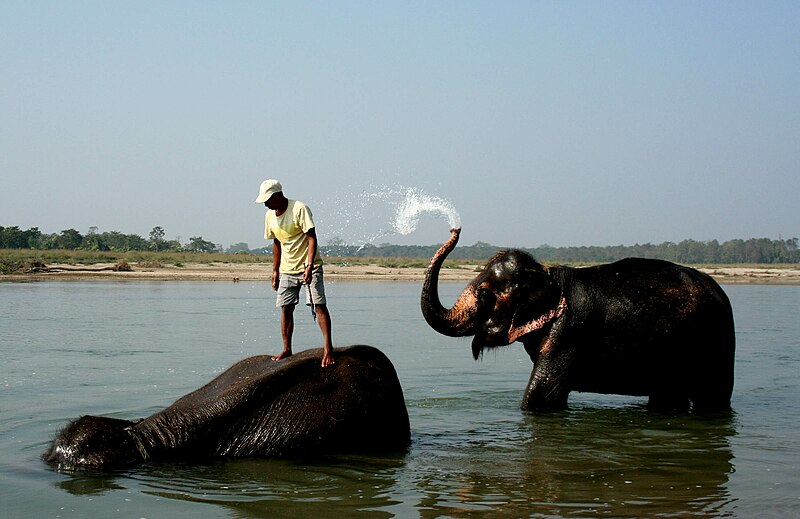
Photo: Wen-Yan King


Wednesday, April 15, 2009

Angora Fur Ball Makes Wool

An angora rabbit is one of the oldest domesticated rabbits because of its long, soft hair, which gives it a huge fur ball appearance. It first became popular with French royalty in the 1700s. Today, they are mostly bred for their angora wool, which can be removed by shearing, combing or plucking the hair. In order to keep the hair soft, angora rabbits must be brushed every day, or at least every other day.

Interesting Fact: An angora rabbit’s hair can yield 100 yards per ounce of angora wool.

Tuesday, August 19, 2008

Adorable Animals Week: Odd Couples

This week it's nothing but adorable animals on The Jungle Store blog! Today, we have an odd couple: a cat who's "adopted" a rabbit after its mom died. It's amazing how the cat accepts the rabbit into her family.

Of course, odd couples have happened many times before in the animal kingdom, like when this mother tiger adopted piglets, or when this pony acts like one of the dogs. Have you seen any odd animal couples yourself?

Wednesday, April 9, 2008

Animals in Golf

We are in a bit of a Sports/Animals theme with the NCAA National Championships. (To be fair, we need to say "Congratulations Lady Vols" for your win yesterday!) This week hosts another "major" sporting event that incorporates many animal phrases and references in the game. From its scoring to its history to its playing layout and surfaces, animal terms abound. The game's greatest player is even named Tiger. Of course I'm talking about The Masters.

Legend has it that golf was invented by bored shepherds in Scotland. While tending their flocks, the shepherds would occupy themselves by using their crooks to whack rocks into distant rabbit holes. As happens with humans, the pastime became competitive and the most addictive and frustrating of all sports was born.

Think you're the only one who has snuck away from work to grab a quick 9 holes? James II, King of Scotland, forced an Act of Parliament in 1457 banning golf. Seems his archers and soldiers were too busy playing the game to attend to their military training. Even so, to actually ban the sport offends my Scottish sensibilities. Probably why neither the ban, nor James II lasted for very long.

So "Thank You" to the astoundingly placid nature of sheep. Their unvaried, daily grazing gave the shepherds plenty of empty time. And "Thank You" to rabbits. Their proliferation provided plenty of chances for a "hole in one."


Tuesday, April 1, 2008

Meet the Staff

Do you know of any company pets? Surely you've walked into a little boutique or a quirky bookstore and been met by the cat, dog, budgie or bunny that thinks they run things. Interaction with animals reduces stress, lowers blood pressure and prolongs your good health. We, at the Jungle Store, take our health very seriously and so our President has made sure to give us plenty of company pets to keep us calm and happy.


Malcom likes to stay close by our office's front doors. He's great at letting us know when guests arrive.


We have to keep Norton and Bruno at opposite ends of the warehouse. They tend to fight. Once we installed the company pool though, Norton got a lot happier. He spends the majority of his day there. The staff won't swim with him anymore as he tends to splash.


Patty, Maxine and Laverne help us oversee climate control. They get rather territorial about that thermostat.


Last week it was my turn to sort out a brief altercation among the Jamison Brothers. I don't know how many times we have to say it. Everybody gets just one donut on Fridays.


Iggy spends the warmer part of the day keeping the parkway free of weeds. What would we do without him?

Susan tends to the landscaping. She'll probably need more staff before the summer is over.


Last but not least, when something absolutely, positively must be there overnight, we ask Spike to take it. He's got a way with big packages.
Happy April Fools

Saturday, March 29, 2008

The Generalists

Last night, as I contemplated which generalist's story I would tell next, I heard a low-pitched, haunting sound coming through the sparse trees across the street. We have a train crossing a few miles from us, and I love the occasional whistle, especially on a chill and starry night. But this noise was not a train.

In my very suburban neighborhood, there are at least two Owls and they call to each other in the night. I'm pretty sure they are Barred Owls, although I haven't gotten a good look at them. Text books say that Barred Owls can only survive in "old-growth forests," but in the last few years, these owls have rewritten those text books. The largest population of Barred Owls currently inhabits the city of Charlotte, North Carolina. Scientists have tried to determine why and found a rather obvious answer, one the owls hit on years ago. A Barred Owl's preference for old-growth forests is two-fold. First the trees are mature enough to offer holes to nest in. Second, the dense upper canopy keeps the under canopy bare and stunted. Barred owls hunt by sight. They sit in a tree branch and wait for something to move under them. Little or no undergrowth helps in the owl's success, so an old-growth forest makes sense.

Now think of your well-established suburban/urban neighborhood. For our pleasure we line our streets with oaks and elms, watering and nurturing them for size and breadth of branches. Underneath these stately trees, we weekly mow our lawns, providing broad swaths of close-clipped sod. We also provide bird feeders full of seed, and well-mulched flower beds—enticements to small birds and rodents. You've got to think that when the Barred Owls were driven from the old-growth forests and winged their way into our cities, they must have been well pleased. I love having these owls as my neighbors. I'm sure they are helping to curb the rabbit and mice populations and they seem contented as I've heard them, off and on, over the last three years. What I love most about having them nearby, is that they add mystery to an otherwise very middleclass world.

Monday, March 24, 2008

The Generalists

It seems a couple of coyotes are killing small dogs and cats in my neighborhood. You can't blame the coyotes; they're simply doing what coyotes do—trying to find a meal. Of course I understand the sadness of the pet owners too. You would think letting your pet out into the backyard would be a safe thing. After all, we don't live in a wild or remote place even though we do have a park and an area of reserved open space adjoining the neighborhood. More often you hear of wild animals adapting to, even thriving with, a nearby human presence. These animals are usually generalists. That means they have an extensive and varied diet, adaptability to habitat and a clever, resourceful mind. In other words, they have all the qualities that have made us humans so successful.

Coyotes tend to hunt in pairs although small fluid packs of 5 – 6 related adults may join forces for a time. When hunting as a larger group, they will hunt larger prey and do so with coordinated effort, much like a wolf pack. Usually, coyotes prefer smaller game and so have been less of a threat to livestock, and less noticed by humans. Coyotes are opportunistic. As wolf packs are driven out of habitat, or killed off, the coyote has slipped in to fill the predatory niche. Although once a diurnal animal, continued contact with human populations has made them nocturnal. Coyotes can survive on almost anything and include rodents, rabbits, carrion, fruit, insects, vegetables and human garbage in their diet. There's been at least one coyote caught in New York City's Central Park, and a den of coyotes live in Washington D.C.'s Rock Creek Park, keeping down the vermin population and eating nearby road kill. A recent census discovered that close to 2,000 coyotes live in and around the city of Chicago. Although most humans don't realize it, it is generally coyotes that keep neighborhood rabbit populations under control. I know last year our block was, literally, hopping with rabbits. Maybe that's what brought the coyotes. Unfortunately they've turned to easier prey and the rising outrage may prove their undoing. I truly hope that doesn't happen.

Photo courtesy of Justin Johnsen.

Friday, March 21, 2008

The Tale Of Easter Rabbits

Rabbits are not so much a Christian symbol of Easter as they are a harbinger of Spring. Pagan festivals of spring, or Eastre, were all about the growing fertility of the earth. Nothing spoke stronger to that than the prolific reproduction of the rabbit and hare. Did you know female rabbits can conceive a second litter while still pregnant with the first? Uffdah!

The Easter Bunny was brought to America by German settlers. They told their children the story of the "Oschter Haws," a magical rabbit who would hop by in the night and leave beautifully painted eggs. Children were encouraged to decorate their hats or bonnets like nests and leave them in sheltered places in the house or barn for the rabbit to fill. Americans were thrilled to adopt this tradition and, as we do, have expanded on it.


To see our great selection of Easter rabbits and other animals, click here!

Tuesday, March 18, 2008

Animal Phrases

Our association with animals is so immediate and constant, it only makes sense our language would include numerous references to animals or their behavior. Just last week I wrote about the phrase "Mad as a March Hare" (blog entry 3/13). That got me thinking about other odd phrases involving animals and I was curious as to why those phrases got started.

Ever hear the term "Mare's Nest?" I've always known it to mean "a tangled mess, a muddle." If I came downstairs in the morning, without brushing my hair, I was told that my head looked like a mare's nest. Odd. I mean female horses don't lay eggs and they most certainly don't build nests. Could this have been a reference to Greek Mythology and the flying horses known as Pegasi? Were they the elusive equine nest builders? But if so, why were their nests so untidy?

Research into origins led to the phrase's first definition. A Mare's Nest was a hoax or a fraud. This seems to make more sense. If you'd found a mare's nest, you certainly had found something wonderful that simply did not exist. How we moved from the term meaning a sham to the term meaning a shambles is not easily found out. At least it wasn't found out by me. I can only put it down to the extraordinary adaptability of the human being.

Sunday, March 2, 2008

Leaping Animals

Did you know there are competitive Rabbit Hopping Events?

The sport started in Sweden in the 1970s. Since then, it has been exported to Germany, France and the United Kingdom and now not a weekend goes by without an event happening somewhere in Europe. Active registered competitive rabbit hopping owners now number over 4,000.

The hopping events are broken into four areas. There are straight and curved hurdle courses, a long jump and a high jump. The current world record holder for long and high jump is a Danish rabbit. He leapt 3.4 feet high and then accomplished 9.8 feet in the long jump. The sport was brought to the United States in 2002 and is slowing spreading in popularity.

Check out a Danish Competitive Rabbit Hopping competition on the video below:

Monday, December 17, 2007

Christmas Bunny


Cute, huh! This picture is courtesy of owner Trucie Henderson.

Rabbits kept in homes as pets are typically called house rabbits. They need a pen at least 4 times the length of their body. Rabbits can be house broken and allowed the run of the house. They are very social animals and can get along with cats and dogs. However, it is not recommended to have a rabbit in a house with small children, as bunnies startle easily.

If you’re looking for a rabbit or bunny yourself, you might consider adopting one through the House Rabbit Society, an international nonprofit organization that rescues rabbits from animal shelters, or contact your local animal shelter to adopt a rabbit.