Showing posts with label Elephant. Show all posts

Thursday, August 14, 2014

Which Species is The Elephant Shrew Really Related To?

Elephant Shrews are small mammals that only eat insects and are native to Africa. Elephant Shrews resemble rodents or opossums and have scaly tails, elongated snouts are relatively long legs for their size. These long legs are used to move in a hopping fashion much like rabbits. 


Elephant Shrews have been, in the past, classified with shrews and hedgehogs and lumped in with hares and rabbits. However, new evidence shows that the Elephant Shrew is related to mammals such as golden moles, aardvarks and even elephants!


The Elephant Shrew is more closely related to elephants than shrews!

Friday, September 21, 2012

Elephant Appreciation Day

Tomorrow is Elephant Appreciation Day and we’re celebrating with a round up of some of our favorite elephant blog posts from the archives!

Did you know that elephants eat about 350 pounds of food each day and drink 18 to 26 gallons of water? 


In ancient times, elephants were actually used in military combat as battle tanks, and are credited with helping Hannibal with the Battle of the Trebia River against the Romans. 

Here’s a fun video of an elephant playing a xylophone. 


A few more elephant facts for you: Their teeth weigh 9 pounds and they can communicate over a distances of many miles using soundwaves that are so low, humans can’t hear them.


Thursday, June 14, 2012

Animal Facts: How Elephants Communicate

Did you know that elephants communicate in sound waves that are in such a low frequency that humans are unable hear them? This is called infrasound, and the elephants use it to talk to each other over great distances.

Elephant
Can you hear me now?

Wednesday, December 7, 2011

Scientists to Clone Wooly Mammoth

One of the best known and most studied prehistoric mammals; the wooly mammoth was an enormous elephant-like land animal that existed from roughly 150,000 years ago until 1700 BC.
Warmer temperatures in eastern Russia have recently allowed scientists to unearth several well-preserved mammoths, including one containing preserved bone marrow. It may be possible for scientists to extract the DNA from this marrow and combine it with that from an elephant, allowing them to clone the mammoth.

Discovery News reports that Russian and Japanese scientists plan to clone a mammoth within five years. If they are successful, the result would likely be pretty controversial. After all, most of us are familiar with the story of Jurassic Park!

Tuesday, September 20, 2011

Amazing Animal Hand Art

I’ve decided to take a break today from sharing animal facts with you guys to show you some amazing animal hand art I ran across on Illusion King. The detail of this artwork is incredible! In fact, I’d feel bad about washing my hands if I had any of these painted on me; enjoy!


Wednesday, August 31, 2011

The Gigantic Gaur

Though not as large as some domesticated cattle, gaur are the largest wild cattle on earth. In fact, the only land animals that regularly grow heavier than gaur are elephants, rhinos and hippos. The largest male gaur can be ten feet long, stand over six feet tall at the shoulders and weigh well over 4,000lbs!
Gaur are mostly dark brown in color with older bulls appearing nearly black. Males can be identified by the large dorsal ridge on their backs which can extend several inches higher than the rump. Both sexes feature horns that can be over two feet long connected on the head by a grey ridge of fur.

Once common throughout most of southern Asia, gaur populations have seriously declined and fragmented over the last fifty years. Overhunting, poaching and destruction of habitat are the main causes of this, leading to these animals currently being classified as vulnerable and nearly endangered. Their current ranges included portions of India, Vietnam, Cambodia, Laos, China, Thailand, Bhutan and Nepal.

Gaur are not known to be particularly aggressive animals and rarely fight even amongst themselves. Fully grown males are far too large for any natural predator except for tigers, and have even been known to kill tigers in self defense. However, herds near human populations can be short tempered towards both humans and livestock animals.


Wednesday, June 8, 2011

How Animals Keep Their Cool

Now that summer’s here, a lot of us probably plan on spending our free time at the pool. When it’s hot outside, nothing’s better than jumping into some nice, cool water to relax. But, when a/c or an ice-cold dip isn’t an option, our bodies still find a way to keep us cool; we sweat. Animals in the wild don’t have the option to crank up the air conditioner when they get too hot, so they’ve developed their own ways to cool down.
Photo: CoolFox
Now, we all know that dogs will pant when they get hot, as their tongues are very effective at releasing heat from their bodies, but did you know they also sweat from their feet? Dogs don’t have a lot of sweat glands like we do, but if overheated they can sweat from between their toes. Other mammals such as squirrels sweat in this same way. Cows can sweat from their muzzles, and rabbits sweat from their lips, though neither nearly as much as humans. Birds have no sweat glands at all, so they will flare their feathers and open their mouths in hot weather to increase their surface area and evaporate water from the surface of their bodies.

Photo: Rene Modery
 Have you ever heard the phrase “sweating like a pig”? Well, that’s not really possible, because pigs don’t sweat at all. To regulate their body temperatures, pigs have to roll in mud or water, which draws the heat from their bodies. They look like a mess, but they’re just trying to stay cool!

Photo: Andrew Smith
Cold-blooded animals such as reptiles, amphibians, and fish have body temperatures that are the same as the air or water around them, and do not sweat. Land-going reptiles that are too hot will do their best to find shade or burrow into cool soil. If shade is not available, some have the ability to lighten their skin color, making it more reflective. Fish often seasonally migrate to deeper, cooler waters to regulate their temperatures.
Photo: Phillip Halling
Of course, we’re not the only ones who enjoy a nice swim in hot weather. Have a safe and happy summer!
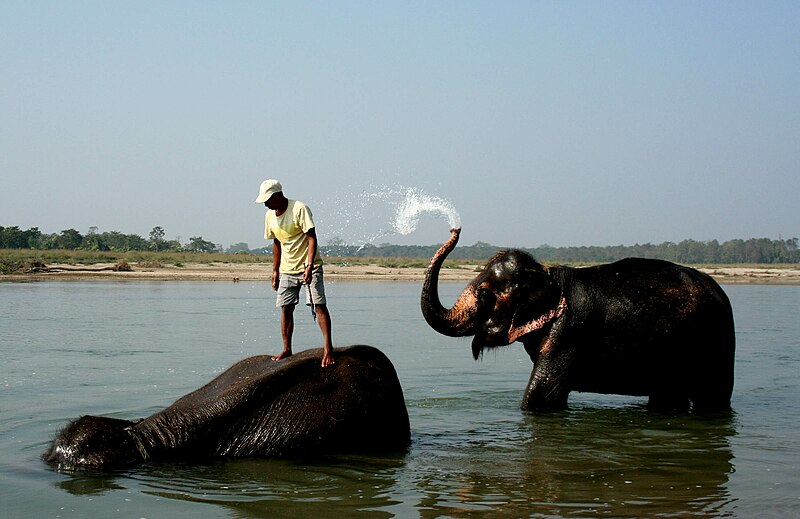
Photo: Wen-Yan King


Thursday, December 10, 2009

The Standing Dugong

Dugongs are giant vegetarians that reside in the warmer coastal waters that range from East Africa to Australia. Their closest relative is the manatee; they are similar in appearance and behavior, even though the dugong's tail resembles that of a whale. Both dugongs and manatees are related to the elephant, even though neither have its same appearance or behavior. Dugongs can stay underwater for six minutes at a time, and sometimes "stand" up to breathe on their tail with their heads above water.

Bonus Fact: These animals are said to have inspired ancient stories of mermaids and sirens.

Thursday, October 22, 2009

Adopt a Crittercam Animal

Did you know that you can adopt a crittercam animal? Scientists learn how to protect endangered animals by studying their behaviors and the habitats they live in. And the only way to do that is by following them with a camera. Donate and watch a Humpback Whale, Elephant, Gray Seal, Loggerhead Turtle or White Shark in their environment. You can learn new animal behaviors and support scientific research with your donations. Check it out at NationalGeographic.com.

Wednesday, July 29, 2009

Weighing in on Elephant Teeth

Did you know that one elephant's tooth weighs about 9 pounds? The average human tooth weighs less than 10 grams!

Friday, April 3, 2009

Whole Lot of Food

Elephants eat about 350 pounds of vegetation each day. They require 18 to 26 gallons of water daily; however, some drink about three times that. A male elephant alone can drink up to 55 gallons of water in less than five minutes. Because they require such a large amount of consumption, elephants spend 16 to 18 hours (about 80 percent) of their day feeding.

Friday, February 27, 2009

Don't Get Too Tired: The Weekend is Almost Here!

Happy Friday! If you’re a little tired from a long week’s work, you’re not alone! In fact, all animals yawn when they’re tired. So, check out these different examples of yawning — but beware! — it’s contagious.


Thursday, October 30, 2008

Wednesday, September 3, 2008

Two Abused Elephants Reunited after 23 Years

I recently read a heartwarming story in Reader's Digest about the reuniting of two elephants after 23 years of abuse at the Elephant Sanctuary. Here's the beginning of it. Read the full story of Jenny and Shirley here!

A circus refugee, Jenny had often been tied up for 23 hours a day or crammed into small train of cars traveling from one city to the next. After suffering a crippling leg injury, she was dumped at a dog-and-cat shelter, which was ill-equipped to care for an elephant, let alone an ailing one. An animal rights activist contacted Buckley, who brought Jenny to Hohenwald.


When Jenny was released into the sanctuary, that’s when she stumbled on a friend from the past...but would they remember one another?
The Carol Buckley Elephant Sanctuary, started in 1995, offers what Buckley considers the three staples for a happy elephant: freedom from dominance, room to roam and lots of other elephants. At the 2,700-acre preserve, the 19 African and Asian elephants in residence are allowed to exist as they would in the wild. Elephants in zoos and circuses are typically moved with a tool called an ankus, a nasty-looking wooden shaft with a metal hook protruding from the top. It’s banned at the sanctuary. Instead, there is a system where dominance does not exist at all, and elephants have the option to refuse to cooperate with humans.

Read more about elephants on our Elephant Facts page.

View more pics of the Elephant Sanctuary here.

Friday, May 9, 2008

Good Mothers - Elephants

Hello, Readership! I was not lost in the deepest darkest parts of Africa. I've been on Jury Duty. Some may consider that comparable, but it was actually quite interesting to see the inner workings of our judicial system.

This week, or for what's left of it, I'm going to write about the Good Mother, since we'll be celebrating Mother's Day this coming Sunday, May 11th. You know, when we see someone acting horribly or out-of-control, we say they're "behaving like an animal." That is patently unfair to animals. They are not all creatures of mere instinct and habit. Animals can form complex social structures and develop deep attachments to each other and humans.

Elephants are such animals. Their bonds are lifelong and even last past death. After a gestation period of 22 months (yes, 22 months), the soon-to-be-mother will choose an "Auntie" from the predominantly female herd and retire to a secluded area to give birth. The Auntie is there to help the mother and protect her and the calf during labor and the birthing process.

Elephant mothers dote on their young, investing 4 or more years in suckling alone. They take great care in guiding and teaching their children, even meting out discipline in the form of a trunk slap on the flank or rump. Mothers are aided in their child-rearing by the entire herd, which is made up of sisters, nieces, cousins, mothers and grandmothers. Daughters will stay with their mothers and the herd they are born into for the rest of their lives. Sons will remain with their mother until they are approximately 15 years old, when they will join smaller male groups.


Photo taken by Sandra Fenley

Thursday, April 24, 2008

Scoop the Poop Week - Zoos

You were all so tolerant with my "pick up after your dog!" harangue that, as a reward, I'm taking you to the zoo. Let's face it, if there's one place you know they're going to have scooping issues, it's the Zoo. One Asian elephant can produce more than 500lbs of poo in a single day!

When I lived outside of Washington DC I was a FONZ. (That stands for Friend of the National Zoo.) Being a FONZ gained you certain privileges, one of which was an inside scoop on what was happening at the zoo. That's how I found out about "Zoo Doo." Zoo Doo was probably the most "natural" solution to a difficult problem – namely what to do with all the poo. They had it made into garden art. You could purchase poo pottery, place it in your garden, and have a somewhat attractive, naturally decomposing source of nutrients for your plants and soil. A win-win as far as I could tell. I'm not sure if the National Zoo is still involved in this program. I wasn't able to find any information on it. But, I did find a company in New Zealand that must have latched on to the same idea. They sell Endangered Feces statuary. Brilliant stuff.


If you live near a zoo, it may be worth contacting them regarding their disposal of waste. They've obviously got the supply, you could make the demand. The Woodland Park Zoo outside of Seattle, WA offers up Elephant dung by the gallon.

Of course, if you'd rather have a more lasting piece of statuary that doesn't have its own special aroma; you may want to check out the Jungle Stores Lawn and Garden area.

Friday, March 7, 2008

Animals In Literature

Rudyard Kipling wasn't just the author of The Jungle Book. He also penned the delightful Just So Stories. In these tales, Kipling explained to his readers how animals became the way they are today. He talked to us as his own children, frequently calling us "Best Beloved," and used rhyme and repetition to entertain.

Perhaps the most famous of these stories is The Elephants Child. In the tale, elephants only have funny, stubby noses. It takes an elephant, a new elephant, an elephant's child "full of 'satiable curtiosity" who travels to the "great grey-green, greasy Limpopo River, all set about with fever-trees" and returns with a glorious trunk. But to find out how he got it, and what he did with it, you'll have to read the book.

Kipling also told us How the Leopard got its Spots, How the Whale got its Throat, and How the Rhino got its Skin. In The Crab who Played with the Sea, we find the reason for tides and in The Butterfly that Stamped we learn the benefits of being humble. He introduced us to exotic places and intriguing animals. I didn't even know there was such a creature as a mongoose until I read Kipling's story of Rikki-Tikki-Tavi.

I have always loved Kipling's animal stories. Not because he takes his characters and imbues them with human traits, but because he imbues them with more than human traits. His animals are wiser, more tolerant, more just and far nobler than we humans could hope to be.

Thursday, March 6, 2008

Animals in Literature

Could The Jungle Store blog not mention
Rudyard Kipling's classic, The Jungle Book? I say, nay nay.

I'm not talking about the Walt Disney movie. That movie is fine, if you're four. But think of how the movie ends – the storm, the fire, the fleeing tiger. In the book, this pivotal battle between the boy, Mowgli and the lame tiger, Shere Khan takes place at the end of Chapter One. If you've only seen the movie, think how much of the story you're actually missing. And it's a wonderful story.

We learn the secretive past of Bagheera the black panther. We watch Kaa, the python rock snake (who is always a friend, never a toadie of Shere Khan) do a "dance of hunger" thereby saving Mowgli's life. We learn the "strangers hunting call" and feel the fierce joy of running with the wolf pack. During a terrible night of darkness we hear Mowgli command Hathi, the elephant, and his sons to "let in the jungle" on an Indian village that has betrayed him. There is mystery and passion in The Jungle Book that no animation can touch. Instead, this novel requires the unrestricted imagination of a child or the willingness of an adult to loose himself in a good book.


Monday, March 3, 2008

Animals in Literature

It's Read Across America week! The NEA (National Education Association) celebrates Dr. Seuss's birthday by encouraging all of us, especially children, to open a book and have a good read. Here at The Jungle Store, we're going to celebrate by remembering some of our favorite children's books and the animal characters that made them so special.

Let's start with a Dr. Seuss classic - Horton Hears a Who.

Horton is an elephant who lives in the Jungle of Nool. The Whos are a race of people living on a dust speck. They ask Horton for his help and protection. Horton is the only one who hears them, and he does defend them, against a buzzard, some apes and a sour kangaroo.

Elephants are social and gregarious creatures. Although their sense of smell is keenest, they communicate with one another by sound. Elephants produce a number of sounds, but perhaps the most interesting is a low-frequency vocalization that lets herds and individual elephants keep in contact with each other. These sounds are loud and can be heard for 5 or 6 miles. But not by the human ear. To humans, the elephants aren't making any sounds at all.

So here's to elephants who listen so well they hear things we don't, perhaps even Whos. And here's to Horton who taught us, "a person's a person. No matter how small."

Saturday, November 17, 2007

Smaller ears than the African elephant

Asian elephants reach almost 10 feet tall, 21 feet long and 11,000 pounds, and are smaller than the African elephant! They live in Bangladesh, Bhutan, Borneo, Cambodia, southern China, India, Indonesia, Laos, Malaysia, Myanmar (Burma), Nepal, Sri Lanka, Thailand, and Vietnam.

Asian elephant females don’t have visible tusks. Asian elephants also have two bulges on their forehead, while African elephants have flat foreheads.

Loss of habitat is their primary threat to survival.

I mentioned in a previous entry that I got to feed a baby elephant in Thailand. We also watched demonstrations of trained elephants moving logs, manuvering over obstacles, and more. As big and powerful as they are, it's hard for me to imagine standing next to a bigger elephant.


JJ