Showing posts with label Turkey. Show all posts

Monday, September 9, 2013

Multiple Turkey Mates

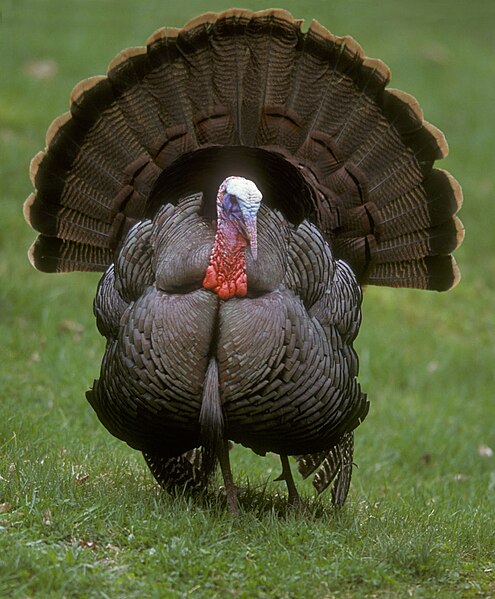
 Male turkeys (toms) will mate with several female turkeys (hens) during the mating season.


Toms will spread their tale feathers, much like a peacock, and drag their wingtips on the ground, strutting and gobbling to attract hens.  Toms will stake out a territory and fight with other males while they try to gather four to six hens for their harem.

Wednesday, November 21, 2012

Picture Of The Week - Run Aways

What do you think these turkeys are thinking? In the spirit of Thanksgiving humor, we imagine it's something like "Run, boys! I heard them say something about stuffing"! They're running away from the Thanksgiving table, we think, and into freedom :-)


Monday, November 19, 2012

Talking Turkey

Did you know that when a male turkey gets excited, his head turns blue? And when he gets angry it turns red. Did you know that domestic turkeys are commonly bred to have white, not brown, feathers as well has larger breasts muscles?


If you're wondering about the bird you'll be eating this Thanksgiving, check our these blog posts from our archives for a variety of turkey facts!

Wednesday, November 23, 2011

Wild Turkey Facts

The turkey has been an important part of Thanksgiving dinner in the United States and other holiday meals throughout much of the world for centuries. However, every bird that makes its way to the table this week is actually a descendant of one of the six subspecies of wild turkey; native only to North America. Here are a few facts about this uniquely American bird.


  • Wild turkeys are significantly smaller and lighter than domesticated turkeys. Males usually weigh under 24 pounds and females less than     12 pounds.  
  • Wild turkeys have between 5,000 and 6,000 feathers. 
  • Unlike their domestic cousins who can't leave the ground, wild turkeys are very capable and agile fliers.
  • By the early 20th century, wild turkeys were nearly wiped out due to hunting and habitat loss. Conservation efforts begun in the 1940s have proved so successful that the species now exists in areas where it did not originally naturally occur.

Monday, October 10, 2011

The Columbian Exchange

Christopher Columbus first arrived in the Americas on October 12th, 1492. Columbus Day is celebrated in the United States today in memory of that event and how it undoubtedly changed the world forever. One of the biggest impacts his arrival had was due to the number of animals and crops introduced to the New World; this is known as the Columbian Exchange.

From a biological perspective, both North and South America were very different places before European settlers arrived. With the exception of alpacas and llamas there were virtually no large animals in the Americas suitable for domestication. The Europeans introduced cattle, sheep, goats and of course, horses; all animals considered vital to both the history and modern economies of the Americas.
The new presence of these animals, all either nonnative or extinct in the Americas for thousands of years, changed life for native peoples significantly; large livestock animals allowed farming cultures to become ranching cultures, and the horse allowed native tribes the nomadic freedom to hunt large animals such as bison.
With trade between Europe and the Americas open for the first time, some New World animals were introduced to Europe as well. Turkeys, llamas, alpacas and guinea pigs were all introduced to Europe and Asia, where they are now common.
Though there is some debate over who actually “discovered” the New World, there is little doubt that the animals introduced during the Columbian Exchange affected it in a very profound way.

Friday, July 1, 2011

The Turkey - Almost A National Symbol

There is perhaps no greater symbol of our country than its national bird, the bald eagle. With its regal appearance it’s easy to see why the bald eagle was chosen by congress to represent America rather than the  wild turkey that Benjamin Franklin was campaigning for. In a well-known letter he wrote to his daughter in 1784, Franklin made his feelings about the national bird known.

“For my own part I wish the Bald Eagle had not been chosen the Representative of our Country. He is a Bird of bad moral character. He does not get his Living honestly. You may have seen him perched on some dead Tree near the River, where, too lazy to fish for himself, he watches the Labour of the Fishing Hawk; and when that diligent Bird has at length taken a Fish, and is bearing it to his Nest for the Support of his Mate and young Ones, the Bald Eagle pursues him and takes it from him.

With all this Injustice, he is never in good Case but like those among Men who live by Sharping & Robbing he is generally poor and often very lousy. Besides he is a rank Coward: The little King Bird not bigger than a Sparrow attacks him boldly and drives him out of the District. He is therefore by no means a proper Emblem for the brave and honest Cincinnati of America who have driven all the King birds from our Country...

I am on this account not displeased that the Figure is not known as a Bald Eagle, but looks more like a Turkey. For in Truth the Turkey is in Comparison a much more respectable Bird, and withal a true original Native of America... He is besides, though a little vain & silly, a Bird of Courage, and would not hesitate to attack a Grenadier of the British Guards who should presume to invade his Farm Yard with a red Coat on.”

We can gather from his letter that Mr. Franklin was not too big a fan of the bald eagle. But in the end, congress got their way; the bald eagle received national symbol status and the turkey got...Thanksgiving.

Wednesday, November 25, 2009

Animal Facts - Turkey Senses


Aside from their underdeveloped smell and taste, turkeys have very strong senses. They can see in color and have a wide field of vision (around 270 degrees) due to the position of their eyes, which also enables them to see two objects at once. They also have excellent hearing even though they don't have external ears, and can pinpoint sounds from as far as a mile away. Their beaks and feet highly sensitive to touch, which helps them while foraging for food.

Tuesday, November 24, 2009

Typical Male Turkeys


Only male turkeys have the "typical" turkey attributes, including the ruffled feathers, fanned tail and bright-colored beard. Like a peacock, the male turkey, which is called a "tom", uses its tail plumage to attract females. It also has a distinctive gobble can be heard a mile away.

Monday, November 23, 2009

Animal Facts - Funny Turkey Names


Turkeys have some funny names for the parts around their head and neck. They include: the caruncle (fleshy bumps on the head and neck); the snood (long flap of flesh that hangs over the beak); and the wattle (red skin that hangs from the neck).

Monday, November 24, 2008

Happy Thanksgiving! Fun Turkey Facts

Here are a few fun facts about turkeys that you can share with your family and friends during Thanksgiving dinner. To learn even more about turkeys, visit the turkey animal facts page.
  • Turkeys have heart attacks. When the Air Force was conducting test runs and breaking the sound barrier, fields of turkeys would drop dead.
  • Turkeys can drown if they look up when it is raining.
  • Turkeys spend the night in trees. They fly to their roosts around sunset.
  • Turkeys fly to the ground at first light and feed until mid-morning. Feeding resumes in mid-afternoon.
  • Gobbling starts before sunrise and can continue through most of the morning.
  • A wild turkey has excellent vision and hearing. Their field of vision is about 270 degrees. This is the main reason they continue to elude some hunters.
  • A spooked turkey can run at speeds up to 20 miles per hour. They can also burst into flight approaching speeds between 50-55 mph in a matter of seconds.
  • In 2007, the average American ate 17.5 pounds of turkey.
  • The heaviest turkey ever raised was 86 pounds, roughly the size of a large dog.

Wednesday, February 20, 2008

Presidential Pets

It seems appropriate that the President who gave us Thanksgiving, should also be the one who had a Turkey as a pet. In 1863 Abraham Lincoln declared the last Thursday in November to be a day of thanksgiving. In preparation, a live turkey was added to the White House menagerie. President Lincoln's son, Tad, grew fond of the bird and named him Jack. When the time came for Jack to be served for supper, Tad pleaded for his life. Abraham Lincoln obliged and granted Jack, the turkey, an official pardon.

This tradition has continued from at least the 1970s. Two presidential turkeys, destined for the table, receive a last minute Presidential Reprieve and live out their lives in comfort. In the last few years, the American public has been asked to name the birds. In 2007 they were dubbed May and Flower. Voting takes place on the White House website.


Thank you Nanette for the delicious Turkey picture