Showing posts with label Ocean Life. Show all posts

Friday, September 28, 2012

Friday Facts - Blue Whales & Their Mouths

Did you know that the blue whale has the largest organs of any in the animal kingdom? Its tongue alone weighs about 3 tons!


When expanded, the mouth of a blue whale can hold up to 99 tons of food and water; however, in a cruel twist of nature, the size and dimensions of its throat doesn't allow it to swallow anything larger than a beach ball!

Monday, June 25, 2012

The Kansas City Sea Life Aquarium

Last week, we finally had the opportunity to visit one of Kansas City’s newest attractions, the Sea Life Aquaruim. And let us tell you, we were impressed (and are already planning for our next trip there)!


One thing that jumped out at us was the easy way that the aquarium blended learning with entertainment. There were “Fin Facts” splashed against many of the walls, teaching visitors things like that the lion fish has a venomous spine on its dorsal fin. There were other displays that showed, rather than told, the facts, like the one with life-sized crab images on it. The images went from the pea crab (aptly named since it is the size of a pea) to the gigantic (and somewhat horrific) Japanese spider crab that grow up to 13 feet in diameter!


The sea life aquarium also does a great job of mixing up the displays. It’s not just a bunch of fish behind glass. There’s that, but there’s also a touch pond where visitors are welcomed to touch star fish, hermit crabs and spiny urchins. There are displays that have special designs so visitors can actually stick their heads inside "bubbles" inside the aquarium.

One of the star fish in the touch pond.

Overall, we were VERY impressed, captivated, entertained and educated by the Sea Life Aquarium and we’re very glad we splurged on the season pass*! This way we can go back all year long to bring our readers (and Facebook fans and Pinterest followers) more great pictures all year long!

*If you live in Kansas City and are considering a trip to the aquarium, definitely check into the annual pass. Price for an individual ticket for the day was about $26, and the price for an individual year pass was $60 (both including tax). If you want to go more than once (and you will) or have a bigger family, it makes sense to get the annual pass.

Thursday, June 7, 2012

Celebrate World Ocean Day

June 8 is World Ocean Day, a day meant to celebrate the bodies of water that link us all together, and to raise awareness about conservation and keeping our oceans clean. Did you know that our oceans account for 71% of the planet, but less than 2% of them are protected?


So how you can help World Ocean Day? Try one of these activities, courtesty of OneWorldOneOcean.org!
  • Organize a beach clean up (or river clean up if you don't live by the coast).
  • Cook a sustainable seafood dinner.
  • Visit an aquarium or marine park.
  • Watch a movie or show that celebrates the ocean: The Living Sea, Coral Reef Adventure, Dolphins, The End of the Line, The Cove, Blue Planet, Dolphin Tale, The Present, the list goes on...


Another way you can celebrate World Ocean Day? Make a donation! Below are a few conservation organizations that are raising money to help fight pollution, overfishing and other threats to our waters.

Monday, May 21, 2012

Rare Calico Lobster Found In Restaurant Tank

An extremely rare (we're talking a 1-in-30 million specimen) calico lobster was recently found in Maine, in the 1,200 gallon lobster tank at Jasper White's Summer Shack Restaurant, to be exact. The lobster was rescued from becoming dinner after the staff noticed it's unusual orange and yellow coloring.


It was a bit of good fortune that save the lobster, which Chef Jasper named Calvin, from the boiling pot. As he told The Boston Globe: "We happened to be cleaning the tank and I happened to be there," White, who has presided over a number of Boston restaurants since the late 1970s, said last week. "One of my guys said, ‘Chef, look at this lobster,' and from across the room I knew it was special."

Calvin was picked up by the New England Aquarium and will eventually make a permanent residence at the Biomes Marine Biology Center in Rhode Island. The calico lobster is the second most rare lobster, coming behind only the white lobster which are an estimated 1-in-100 million specimen.

Thursday, May 3, 2012

The "Psychadelic" Mandarin Fish

The Mandarin fish is easily one of the prettiest fish in the sea, which explains why it is one of the most popular fish sold for reef aquarium tanks. Its scale-less body features a beautiful display of blue, green, orange and yellow designs and squiggles.

Although the Mandarin fish is highly sought after for fish tanks, their finicky eating habits make it hard for them to survive in a closed environment. According to this website, they feed only on "amphipods and copepods, which are found in sufficient numbers only in larger and well established reef tank." Many Mandarin fish starve in pet shops or new tanks.


In the wild, Mandarin fish is native to the Pacific Ocean area, from the Philippines to west of Australia. The travel in groups or pairs and live in lagoons and the sandy bottoms along coral reefs.

Wednesday, April 25, 2012

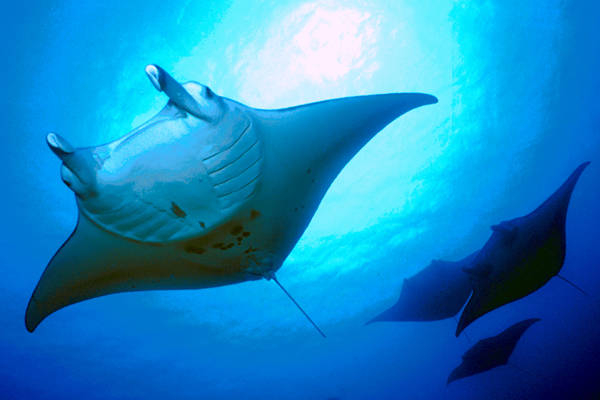
The Giant Manta Ray - Enigma Of The Sea

The giant manta ray is a bit of an enigma in the ocean world. Though they are the third-largest sea creature, with only whales and sharks being larger, not much is known about them. Their large size (up to 25 feet across and 5,300 pounds!) makes it extremely difficult to keep one in captivity for observation. Currently there are just four giant manta rays in captivity.


The term manta is Spanish for blanket and it aptly describes the look of the rays’ large “wings” as they swim. They are extremely strong swimmers, and it’s possible they are able to swim across the open ocean.


Manta rays live in tropic and sub-tropic waters. They frequently visit “cleaning stations” where small fish swim over their skin, feeding on dead tissue and parasites. Manta rays themselves are bottom feeders, eating things like plankton and fish larvae.

Images via here and here.

Tuesday, March 6, 2012

Clownfish and Sea Anemones - A Working Relationship

Clownfish are a prized addition to most any collector’s aquarium, as their bright colors are quite beautiful. However, in the wilds of the open ocean these small fish have little in the way of natural defenses, and there are plenty of hungry predators that would love to have them for lunch. What’s a clownfish to do? Find a much bigger best friend!
TheJungleStore.com | Clownfish and Sea Anemones

Clownfish share a symbiotic mutual relationship with sea anemones, predatory animals closely related to corals and jellyfish. The sea anemone inhabits coral reefs and uses its stinging tentacles to paralyze prey and enemy alike. Using fast-acting toxins for both offense and defense makes the anemone seem rather a self-sufficient creature, yet it harbors, even welcomes, the small tropical clownfish to take up residence among its tentacles.

The clownfish not only gets a wonderful living defense system from the anemone, but also an occasional meal from the scraps of fish the anemone fails to ingest. This relationship works both ways as the anemone will snack on any scraps the clownfish drops as well. The action of the clownfish also stirs up fresh water currents and moves them over the sedentary anemone.

TheJungleStore.com | Clownfish and Sea Anemones

So, how does the anemone know not to sting? There are a few different theories. One is that the anemone doesn't know, but that the mucus coating of the clownfish protects it from the anemone's toxins. This is possible because clownfish that have had this mucus wiped off of them have been stung and killed by their previous hosts. Another theory states that the chemical content of the mucus coating prevents the anemone from recognizing the clownfish as a food source, and therefore the anemone fails to react to the little fish's presence.

Monday, September 28, 2009

Giant Clams Have Only One Home

The giant clam is the largest mollusk in the world, growing up to 4 feet long and weighing over 500 pounds. It gets only one chance to find a home. Once it places itself in a certain part of a reef, it stays stuck there for the rest of its life. Giant clams primarily live in warmer waters, like the Indian Ocean and South Pacific. Their massive size comes from sugars and proteins consumed from algae that they provide homes for. Although there have been several rumors, the giant clam is not a man-eater, and there is no record of a giant clam-related human death.


Bonus Fact: All giant clams have different coloration; no two are alike.

Thursday, July 2, 2009

Don't Touch a Lionfish

The lionfish, also known as the turkey fish, dragon fish and scorpion fish, is small, but deadly to most animals that touch it. Its 18 twig-like dorsal fins are equipped with venom used mainly for defense. It uses its feathery fins to group small fish into a smaller space, where the lionfish can then swallow them. Although the lionfish carries venom, it rarely causes death in humans.

Wednesday, May 13, 2009

The Indonesian Mimic Octopus, A True Impersonator

The Indonesian Mimic Octopus is naturally brown and spotted, but it has the ability to turn any color or pattern it wants. This sort of camouflage is extremely rare. While many animals can change color and skin texture, the Indonesian Mimic Octopus is the only one that can take on the same shape and features of its surrounding environment, including features of other species!
TheJungleStore.com blog - The Indonesian Mimis Octopus
Now you see me...
TheJungleStore.com - The Indonesian Mimic Octopus
Now you don't!
It can copy the physical characteristics and movement of more than 15 different species, such as sea snakes, jellyfish, stingrays and giant crabs, to name a few. In fact, this octopus can figure out which animal to impersonate, depending on how threatening it needs to be to its current predator. Watch the video below to see for yourself!

Monday, May 11, 2009

Oyster Love

Oysters are ambisexual, meaning they can change from male to female and back again. While oysters are born male, they have both sex organs to be either a male or a female.

Wednesday, February 18, 2009

Seahorses Are Tiny, But Unique

The seahorse is a true aquatic gem that adds another splash of originality to life under the sea. Not only does it have a unique shape, it is one of few fish that are monogamous and mate for life. Even more interesting, the seahorse is the only animal species where the male — not the female — bears the eggs until they hatch. When they do hatch, they release as fully-formed, tiny seahorses.

Another seahorse tidbit: Seahorses don’t have a stomach. Because food passes through them so quickly, they have to eat constantly to stay alive. They can consume more than 3,000 brine shrimp each day!

For more on seahorses, visit NationalGeographic.com.

- Photo by Laurent Ballesta/ National Geographic