Friday, May 10, 2013

The Anteater's Non-Paw Crawl

While it might not look like it from a distance, an anteater actually does not walk on it's paws.


Picture from Houston Zoo

Instead, with the claws curled up into the paws, it walks on its "fists." This helps to keep the claws sharp so the anteater can dig into ant mounds or defend itself from predators.  It is important for an anteater's claws to be as sharp as possible as it often has to fight off jaguars and pumas.

Thursday, May 9, 2013

Cheetah Chat

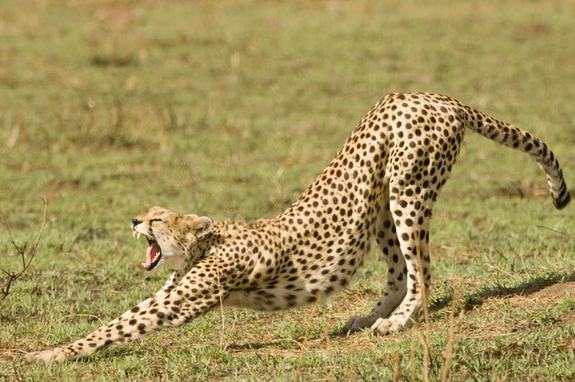
A cheetah while ranking among the more vocal felines, can not roar.

 
Picture from Live Science

Cheetah's make numerous other noises, such as chirping, churring, growling, and purring.  A mother cheetah chirps when she's trying to locate her cubs.  Churrs are emitted during social meetings.  You'll often hear a cheetah growl when they are annoyed or face danger.  And just like a kitty, a cheetah will purr when it's content.

Wednesday, May 8, 2013

Getting Over The Hump Of Camel Myths

Baby camels are born without a hump. They won't develop one until they start eating solid food.

 Picture from HD Wallpapers

Contrary to myth, water is not stored there. A camel's hump is made up of fatty tissue that can be converted into energy and water. As the camel draws upon these energy reserves, the hump shrinks. If the fat deposits are truly depleted, the hump will flop over and hang down the camel's side. A week of food, water and rest will restore a camel's hump to its proper shape.

Tuesday, May 7, 2013

Canadian Geese - Mates for Life

The Canadian Geese share an important feature with some of their feathered friends.  Like Swans, Black Vultures, Turtle Doves, and Bald Eagles, the Canadian Geese mate for life.

Picture from IBC

Typically during the second year of their lives, Canada Geese find a mate. They are monogamous, and most couples stay together all of their lives. However, if one dies, the other may find a new mate.  Males and females almost always pick a mate who is very close to their own size.

Monday, May 6, 2013

Be Kind To Animals Week

Sunday kicked off "Be Kind To Animals Week"!
 

While we think you should be kind to animals every week, this week in particular is designated to commemorate the role animals play in our lives, promote ways to continue to treat them humanely, and encourage others to do the same.

Click here to learn more about Be Kind To Animals Week!

Beautiful Butterflies

Butterfly wings are actually clear. Their colors and patterns are made by the reflection of the scales that cover them.


These scales are pigmented with melanins that give them blacks and browns. Blues, greens, reds and iridescence are usually created by the micro-structure of the scales instead of the pigment.

Friday, May 3, 2013

Nationally Specially-Abled Pets Day

Every year May 3rd celebrates Nationally Specially-Abled Pets Day.  Founded in 2006, this day is dedicated to these incredible and heroic animals, as well as educate the public about caring for specially-abled pets.

Here are a few of our favorite pictures of adorable specially-abled pets!


Baby Bats

A baby bat will have plenty of siblings in it's life, but none the same age.  
 

Female bats generally only give birth to just one pup a year.  Some belief this is because of the mother's need to fly to feed while pregnant.   Female bats nurse their young until they are nearly adult size, because a young bat cannot forage on its own until its wings are fully developed.  Infant mortality is high, (if a baby bat looses a grip on its mother or roost, it will fall and die) but bats that reach maturity can live 30 years or more.


Thursday, May 2, 2013

Beavers Senses Shutdown

A beaver has the ability to shut down two of their senses, smell and hearing.


A beaver’s nose has a special inner flap that seals out water when the beaver is submerged. Adult beavers can hold their breath under water for 15 minutes.  Beaver ears also have inner flaps that seal out water when they are swimming. They have oversized auditory canals, which allow them to pick up sounds and vibrations under water that may indicate danger.

Wednesday, May 1, 2013

Zombees

Zombees are real!  Not the walking dead type zombie, but there is such a thing as a zombie bee, or "zombees" as they are also called.  


Honey bees  in Washington that were acting strangely, were tested and scientists discovered that they had been infected by the parasitic fly apocephalus borealis (also known as the zombie fly). Those bees infected by apocephalus borealis have been dubbed as "zombie bees," or "zombees".  The infection has spread to Oregon, California, and South Dakota. Tests are being conducted on bees in several other states to determine if the bees there are infected.  Bees infected with the apocephalus borealis fly cannot spread the infection to humans.