Showing posts with label Shark. Show all posts

Thursday, June 21, 2012

Animal Facts - The Black Tipped Reef Shark

Time to cue the "Jaws" music! The black tipped reef shark, which lives off the coasts of the Indian and Pacific oceans, prefers to swim in very shallow waters, sometimes not more than a foot deep! They can often be seen swimming along the shore, with their dorsal fin sticking up out of the water.


Learn more about the black tipped reef shark in this blog post from our archives!

Tuesday, September 27, 2011

Today's TV Star - The Blacktip Reef Shark

If you caught today’s episode of The Martha Stewart Show, and we hope you did, you may have noticed one particular plush shark used in the stuffed animal craft segment had signature black fins; the blacktip reef shark
The real blacktip reef shark is a relatively small shark common to the shallow, warm waters near coral reefs in the Indian and Pacific Oceans. Although they mimic their larger cousins in appearance, blacktip reef sharks are rarely more than five feet long and are quite timid around humans.
Easily identified by the black tips on their fins, these sharks feed on a large variety of small fish and squid that make their homes in and around reefs. However, due to their small size, blacktip reef sharks are sometimes preyed upon by larger bony fishes such as groupers.

Because these sharks live in shallow waters close to shore, interactions with humans are frequent. Divers are encouraged to swim fully submerged rather than wading through the water when blacktip reef sharks are present. The sharks will almost always flee in the presence of a diver, but can mistake a wading swimmer’s leg for a meal.
Though not endangered, the blacktip reef shark is considered nearly threatened. They have extremely low reproductive rates, and are overfished in some areas. In addition, their fearsome appearance and modest size make them a popular addition to large aquariums.

Today on Martha Stewart – The Jungle Store’s Plush Sharks!

We’re very excited to announce that this morning a selection of the Jungle Store’s plush sharks will be featured live on The Martha Stewart Show!

Today’s show will feature a selection of Martha’s summer finds; new recipes and craft projects that inspired her over the summer. For the craft segment, Martha and designer Kelly Behun will be transforming a school of the Jungle Store’s plush sharks into a delightful chair and throw pillow!

The show is scheduled to air live at 10:00am EST this morning, so be sure to check your local listings or Martha’s website so you can tune in!

If you’re interested in picking up any of the sharks you see on the program for your own craft project, be sure to visit the Jungle Store’s selection!

Friday, September 9, 2011

Surfing with Sharks

Some pictures taken in San Diego last weekend may be a little bit shocking for those with a fear of sharks. They show surfers waiting to catch a wave just a few feet away from what scientists agree is a 12 foot great white.
Lifeguards at the beach originally dismissed the sighting as a duck-diving surfer, but as these photographs were studied more closely it became apparent that it was a shark after all.
While great white sharks can certainly be dangerous to humans, fatalities from shark attacks are extremely rare and great whites do not purposefully hunt humans for food.
Since 1670 there have only been 43 fatal shark attacks in the United States. Surfers and swimmers are statistically more likely to be struck by lightning or win the lottery than be attacked by a great white shark.

All photos via.

Friday, August 5, 2011

Basking Sharks - The Lazy Predators

As we close out this week, we’d like to focus on a shark that just doesn’t get any respect; the basking shark. Although it’s one of the largest species of fish in the world, the whale shark is larger, so it won’t set any records there. It isn’t a vicious predator either, and despite being as long as a city bus poses absolutely no danger to humans or any large creature of the sea.

The basking shark gets its name from its appearance of relaxing (i.e. basking) in warmer waters near the surface while it feeds; and due to their massive size they are quite hard to miss. Basking sharks are usually 20-35 feet in length and weigh about 4 tons. The largest specimen ever confirmed was over 40 feet long and weighed an estimated 34,000lbs!
Basking shark filter feeding
Although basking sharks are sometimes mistaken for great white sharks, the two could not be more different. Whereas great whites are active hunters, the basking shark is a passive filter feeder. It feeds on zooplankton and small fish simply by swimming around very slowly with its enormous mouth wide open. Prey is snagged by the basking shark’s many sets of gill rakers. During this process, the shark naturally takes in a massive amount of water. However, unlike other filter feeding sharks that can close their mouths and pump this water out manually, the basking shark can only expel water by continuing to swim at its lumbering 3mph pace.
Basking shark head
Basking sharks do migrate throughout the year and can travel thousands of miles in a season. It is assumed that this travel is related to reproduction or following plankton blooms. Due to this migration, at certain times of the year basking sharks may be found in nearly every ocean of the world.

Thursday, August 4, 2011

The Thresher - The Shark with a Whip

To see a common thresher shark from the front you may think that it looks a lot like many other sharks. The streamlined, torpedo-shaped body and classic dorsal fin fit the profile perfectly. However, once you see that massive tail the thresher shark is unmistakable.
Pelagic thresher shark - Photo: Discovery
The thresher shark’s massive caudal fin isn’t just for looks, either. When hunting, the thresher will use its tail to slap the water around schools of fish to corral them. There have also been several reports of threshers using their tails like whips to stun or kill prey.

There are three species of thresher sharks. As its name suggests, the common thresher is the most widely distributed species and it is also the largest, reaching lengths of over 20 feet and weights of over 1,000lbs. The pelagic thresher is the smallest at about 10 feet long and less than 200lbs. The third species is the bigeye thresher, which features eyes that can be up to four inches in diameter for hunting in deep waters with little light.

Most thresher sharks prefer open ocean; depending on size and species they feed on a large variety of marine life, but prefer schooling fish such as mackerel and tuna as well as squid. Adult threshers rarely have any natural predators of their own.
Despite their large size and that fearsome tail, threshers pose little or no danger to humans. There has only ever been one reported attack by a thresher shark on a person and just a handful of attacks against boats. All of these attacks we most likely provoked, as the thresher is still highly prized by sport fishermen despite all species being nearly endangered.

Wednesday, August 3, 2011

Hammerheads - Sharks Apart from the Rest

Next to the infamous great white, the hammerhead is probably the most recognizable shark in the world. The distinctive shape of its head is undeniable, but there are a few other things you may not know about hammerheads that make them uniquely different from other sharks.
Photo: Barry Peters
First off, the hammerhead is not just one species of shark. Though the large Great Hammerhead may be the best known, there are actually nine different species of hammerheads in two separate genera. The two largest species are the great hammerhead and the smooth hammerhead at 20 and 16 feet in length, respectively. Most other varieties are significantly smaller, with the 3 foot long bonnethead shark being the smallest.
Bonnethead shark - Photo: Valerie Everett
Unlike most sharks which are lone hunters, hammerheads usually congregate in schools. Depending upon species and conditions these schools can range from just a few individuals to thousands of sharks in a single location. They primarily hunt for crustaceans and small fish near the ocean floor with the largest varieties preferring to hunt stingrays. All except the largest species’ are considered harmless to humans.

Another interesting characteristic is the way hammerheads reproduce. Unlike most sharks, hammerheads do not lay eggs. Rather, their young are nourished in a yolk sack inside the female. After the yolk as been depleted, these yolk sack structures, which are more akin to leather than to an egg, are laid by the female and the pups are born. Hammerhead shark litters can range from 12-40 pups each depending on species.

So what is up with the shape of that head anyway? Like all sharks, hammerheads have electroreceptor sensory pores called ampullae of Lorenzine that allow them to detect the electrical fields given off by other animals. It is believed that the hammerhead’s wide head allows these pores to be more spread out, thus allowing the hammerhead to detect prey more easily than other sharks. It is also thought that the wide spacing of the eyes gives hammerheads binocular vision, and it is known that great hammerheads will use their heads to pin prey against the ocean floor.
Photo: Su Neko

Tuesday, August 2, 2011

Sharks from Small to Huge

As I mentioned yesterday, this week is all about the celebration of sharks. And while tiger sharks and great whites may get most of the press, they are just a small part of the 400+ species' of these amazing animals. Today I thought I would show you the two bookends of the Selachimorpha (shark) superorder size-wise; the dwarf lanternshark and the whale shark.

Dwarf lanternshark - Illustration by Tambja
 The dwarf lanternshark is the smallest known shark species in the world. Found only in the southern Caribbean Sea near Venezuela and Colombia, this rare species of dogfish shark reaches a maximum length of  only eight inches and lives about 1,000 feet below the surface.


Whale shark - Photo by Zac Wolf
 On the other side of the spectrum is the massive whale shark; not only the largest shark but also the largest fish species in the world. Whale sharks of up to 41 feet in length have been confirmed, and they can weigh in excess of 79,000 pounds. In other words, they are as long as a city bus and weigh as much as 25 automobiles. Despite their massive size, whale sharks are not vicious killers. They are filter feeders and subsist mainly on a diet of plankton and small fish. They swallow massive quantities of water containing their prey when they feed, expelling the excess liquid through their gills and swallowing the leftover plankton.

Monday, August 1, 2011

Aquatic Cleaning Stations

While there may indeed be a week-long celebration of sharks on a certain network, today I thought I would present you guys with some of the unsung heroes of the marine world, the cleaner fish.

Like any animal, a fish can develop skin problems, become afflicted with parasites and get generally dirty. Without the ability to take care of any of these problems themselves, some fish have developed a mutually beneficial relationship with one another.

Certain species of fish are known as cleaner fish. They provide a service to other fish (even sharks) by removing parasites and dead skin from their bodies and food particles from their mouths. It’s mutually beneficial because the cleaner fish feeds on what it removes while the client fish reaps the health benefits.

A pair of cleaner wrasses go to work on a client
The best known cleaner fish is called the cleaner wrasse. These are small fish identifiable by their horizontal stripes. They congregate at “cleaning stations” near the sea floor in the Indian and Pacific oceans. When approached by client fish at these stations, the cleaner wrasses will go to work on whatever part of the client that needs cleaned, even swimming into their gills and mouths if necessary. Although the client fish are easily capable of eating the tiny wrasses, they recognize the service they provide and do not prey upon them.

Other marine animals that provide a similar service are several types of gobies and cleaner shrimp.

Friday, May 27, 2011

Hundreds of Whale Sharks Near Mexico

Whale sharks are the largest fish on the planet. As long as a city bus and weighing nearly 80,000lbs, these ocean giants were once thought to be solitary creatures, preferring the open sea. However, recently a group of 420 whale sharks was spotted off the coast of Mexico, according to the Smithsonian National Zoological Park.


Photo: Discovery News

Despite their size and the fact that they are indeed sharks, whale sharks usually feed on very small creatures such as shrimp and plankton. According to biologists, these whale sharks were feeding on a dense patch of fish eggs. It marks the largest documented gathering of whale sharks in history.


Photo: Discovery News

Thursday, December 17, 2009

Head-Butting Bull Sharks

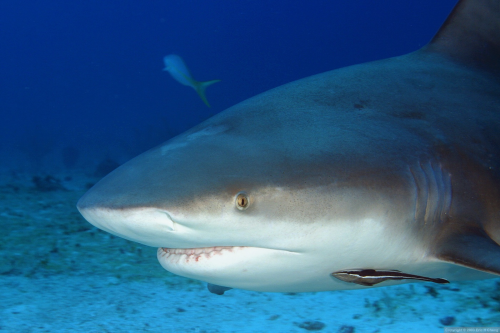
Bull sharks are considered to be the most dangerous sharks in the world because they are aggressive, common and often live near heavily-populated areas like tropical shorelines. They often travel inland, swimming up rivers and tributaries. In fact, they've been found thousands of miles up the Amazon River, heading towards Lake Nicaragua. Along with great whites and tiger sharks, they are one of the three sharks most likely to attack humans. Their name comes from their short snout and their tendency to head-butt their victims.

Thursday, October 22, 2009

Adopt a Crittercam Animal

Did you know that you can adopt a crittercam animal? Scientists learn how to protect endangered animals by studying their behaviors and the habitats they live in. And the only way to do that is by following them with a camera. Donate and watch a Humpback Whale, Elephant, Gray Seal, Loggerhead Turtle or White Shark in their environment. You can learn new animal behaviors and support scientific research with your donations. Check it out at NationalGeographic.com.

Thursday, October 8, 2009

Old Jellyfish and Sharks

Jellyfish and sharks both existed way before the dinosaurs. Jellyfish date back 500 million years and sharks, 400 million years.

Monday, September 21, 2009

Sand Tiger Sharks Come Up For Air

Sand tiger sharks are the only known shark to come to the ocean’s surface and take a gulp of air. The air that they swallow stays in their stomachs, allowing them to float motionless in the water while seeking prey. They can be found close to the shore in warm or temperate waters.

Friday, August 14, 2009

Nurse Sharks Sleep Together

The nurse shark is either named after the sucking noise it makes when hunting for prey that sounds like a nursing baby.Or it may derive from either the word, nusse, which means ‘cat shark’ or the Old-English word hurse, which means sea-floor shark. Either way this shark is less threatening then many of its relatives; however, it is extremely large, growing up to 14 feet in length. Nurse sharks are nocturnal and sleep during the day on the sea floor, in groups of 40 or so. Sometimes they’re even piled on top of each other. 


Monday, August 3, 2009

Learn About Sharks This Week

For all those shark fans out there, this week is Shark Week on the Discovery Channel. I was so enthralled with it last night that I knew I had to tell me readers. I watched scientists prove for the first time that Great Whites hunt at both dusk and when it's completely dark outside. Then, I saw a reenactment of the events that the movie Jaws was based on, which actually happened in 1916 instead of during the '70s. Check out the schedule to see what's on tonight and for the rest of this week's tribute to this dangerous, but ever-so-interesting underwater creature.

Tuesday, June 30, 2009

Sharks Help Cancer Patients

Sharks have an incredible ability to resist disease; in fact, they get sick less often than any other fish. This is probably why they have been around longer than crocodiles, humans or even dinosaurs. Because the shark is much more primitive than the human, researchers are trying to figure out more about the shark’s immune system. Someday they may even use that knowledge to help regulate the immune systems of human cancer patients.

Bonus Fact: Sharks first appeared in the seas 200 million years before the dinosaurs.

Find shark-inspired items at The Jungle Store!

Monday, April 14, 2008

Animals in Golf

Congratulations to Trevor Immelman! He stayed steady and focused and now wears the coveted Green Jacket. There were some attempts to answer my little animal nickname quiz, but nobody got them all, so here goes:

The Tiger (who came in second yesterday) was born Eldrick Woods. His father nicknamed him Tiger and he's now had his name legally changed to Tiger Woods.

The Walrus is Craig Stadler. He earned the nickname due to his enormous moustache that looks much like the walrus's whiskers, or vibrissae. A walrus relies on its whiskers to find food on the muddy bottom of the ocean. Wonder if Stadler uses his to strain his soup?

The Pink Panther is LPGA player, Paula Creamer. Her play is smooth, powerful and focused, much like a panther on the prowl. Since she frequently wears pink, it seems only natural to tag her with a colorful moniker.

The Golden Bear is Jack Nicklaus. He earned the nickname in high school. Upper Arlington High's mascot was the Golden Bear. Of course his powerful swing and his golden hair may have had something to do with it as well.

The Big Cat is another player from the LPGA. Kim Williams is 6ft tall.

The Great White Shark is Greg Norman. His white-blonde hair, and the fact that he comes from Australia, made his nickname easy.

Greg Norman, like other pro-golfers, has used his nickname to create an industry of sportswear, golf accessories, golf courses, etc. You can find almost anything you need for the game with his unmistakable shark logo on it. But, I wonder if Greg has one of these on the back of his golf cart?


I know I'm trying to find a "Beware of the Jungle" one for myself!

Sunday, April 13, 2008

Animals in Golf

Did you see what Tiger Woods did Friday at The Masters? His drive from the 18th tee went way, way right. He landed in the jungle, in the straw, in the trees. There was no way he could use his power or his skill to get out of this mess. Even Tiger Woods can’t drive a golf ball through a tree. So, Tiger used his brains. He hit the ball onto the 10th Fairway. Tenth fairway, you say? Wasn’t Tiger playing the 18th hole? (Obviously he’s been watching how much success I have playing multiple fairways.) Tiger's next shot went from the 10th Fairway to the 18th gree. He made par. Amazing.

Today, Sunday, the last day of The Masters tournament, Tiger Woods is 6 strokes behind the leader. That seems a lot of ground to make up. But, here is your animal fact for the day: Tigers are most successful when they catch their prey from behind!

Tiger Woods is not the only Professional Golfer to be nicknamed after an animal. Can you tell me the real names of the following players? (I’m including Tiger because that wasn’t his given name at birth.) Give them your best shot. Meanwhile I’m going to be working on my short game with this way fun desktop course. (Who says you can't play golf when it's raining?) Answers on Monday!

1. Tiger
2. The Walrus
3. Pink Panther
4. The Golden Bear
5. Big Cat
6. Great White Shark

Check out the Luck of the Leader, Trevor Immelman.

Friday, September 7, 2007

Not really a whale…

Orcas, or killer whales, have striking black and white markings. You, like me, may have seen them perform at places like Sea World. Aren’t they beautiful?

Orca are carnivorous hunters and are sometimes called "the wolf of the sea." They prey on sea lions, elephant seals, harbor seals, porpoises, squid, sharks, fish, penguins, smaller whales, such as belugas and narwhals, and even large baleen whales.

Orca actually belong to the dolphin family. Warm blooded, males (bulls) average 19-22 feet and usually weigh between 8,000-12,000 pounds. Females (cows) are smaller, averaging 16-19 feet, weighing between 3,000-8,000 pounds.

Some day I’d like to be close enough to see one in the ocean. But for now this incredible video from National Geographic will have to do!


Jaw dropping,

Jane