Showing posts with label sea animals. Show all posts

Wednesday, February 6, 2013

Picture Of The Week - A Swarm In The Sea

This photograph, which was taken in 2010, captures a bit of animal behavior that has rarely (if ever) been seen before or since it was taken. German photographer Florian Schulz snapped the image while flying over Baja California Sur in Mexico. It's a mass of Munkiana Devil Rays, swimming toward an unknown destination.


Of the photograph, Schulz said: "Not even my pilot, who has surveyed this area for 20 years, had seen anything like it. As we got closer we started to discover its nature: an unprecedented congregation of rays. The group was as thick as it was wide, all heading towards the same direction. I have asked around why this took place but no one has been able to explain it to me."

The photograph earned him the CIWEM Environmental Photographer Of The Year Award in 2012.

Thursday, June 7, 2012

Celebrate World Ocean Day

June 8 is World Ocean Day, a day meant to celebrate the bodies of water that link us all together, and to raise awareness about conservation and keeping our oceans clean. Did you know that our oceans account for 71% of the planet, but less than 2% of them are protected?


So how you can help World Ocean Day? Try one of these activities, courtesty of OneWorldOneOcean.org!
  • Organize a beach clean up (or river clean up if you don't live by the coast).
  • Cook a sustainable seafood dinner.
  • Visit an aquarium or marine park.
  • Watch a movie or show that celebrates the ocean: The Living Sea, Coral Reef Adventure, Dolphins, The End of the Line, The Cove, Blue Planet, Dolphin Tale, The Present, the list goes on...


Another way you can celebrate World Ocean Day? Make a donation! Below are a few conservation organizations that are raising money to help fight pollution, overfishing and other threats to our waters.

Monday, May 21, 2012

Rare Calico Lobster Found In Restaurant Tank

An extremely rare (we're talking a 1-in-30 million specimen) calico lobster was recently found in Maine, in the 1,200 gallon lobster tank at Jasper White's Summer Shack Restaurant, to be exact. The lobster was rescued from becoming dinner after the staff noticed it's unusual orange and yellow coloring.


It was a bit of good fortune that save the lobster, which Chef Jasper named Calvin, from the boiling pot. As he told The Boston Globe: "We happened to be cleaning the tank and I happened to be there," White, who has presided over a number of Boston restaurants since the late 1970s, said last week. "One of my guys said, ‘Chef, look at this lobster,' and from across the room I knew it was special."

Calvin was picked up by the New England Aquarium and will eventually make a permanent residence at the Biomes Marine Biology Center in Rhode Island. The calico lobster is the second most rare lobster, coming behind only the white lobster which are an estimated 1-in-100 million specimen.

Thursday, May 3, 2012

The "Psychadelic" Mandarin Fish

The Mandarin fish is easily one of the prettiest fish in the sea, which explains why it is one of the most popular fish sold for reef aquarium tanks. Its scale-less body features a beautiful display of blue, green, orange and yellow designs and squiggles.

Although the Mandarin fish is highly sought after for fish tanks, their finicky eating habits make it hard for them to survive in a closed environment. According to this website, they feed only on "amphipods and copepods, which are found in sufficient numbers only in larger and well established reef tank." Many Mandarin fish starve in pet shops or new tanks.


In the wild, Mandarin fish is native to the Pacific Ocean area, from the Philippines to west of Australia. The travel in groups or pairs and live in lagoons and the sandy bottoms along coral reefs.

Wednesday, April 25, 2012

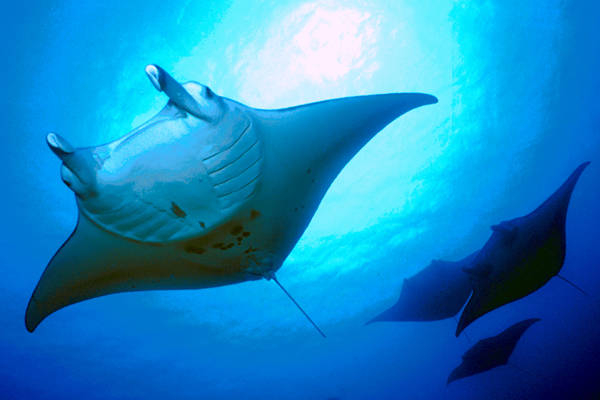
The Giant Manta Ray - Enigma Of The Sea

The giant manta ray is a bit of an enigma in the ocean world. Though they are the third-largest sea creature, with only whales and sharks being larger, not much is known about them. Their large size (up to 25 feet across and 5,300 pounds!) makes it extremely difficult to keep one in captivity for observation. Currently there are just four giant manta rays in captivity.


The term manta is Spanish for blanket and it aptly describes the look of the rays’ large “wings” as they swim. They are extremely strong swimmers, and it’s possible they are able to swim across the open ocean.


Manta rays live in tropic and sub-tropic waters. They frequently visit “cleaning stations” where small fish swim over their skin, feeding on dead tissue and parasites. Manta rays themselves are bottom feeders, eating things like plankton and fish larvae.

Images via here and here.