It seems like stories of people searching for the fountain of youth have been around forever, and as far as animals go there are certainly plenty with much longer life spans than humans. Koi fish have been known to live over 200 years, at least one Aldabra giant tortoiselived to be 255, and a giant barrel sponge in the Caribbean is estimated to be more than 2,300 years old. However, there may be one animal that is indeed impervious to Father Time; Turritopsis nutricula, the immortal jellyfish.
Photo: Peter Schuchert
All jellyfish go through several life cycles. There are born as larvae that settle onto the sea floor or other underwater structure and develop into polyps, which look similar to a tiny octopus with its tentacles pointed up. The jellyfish buds from this polyp and begins its adult life, feeding constantly and growing quite rapidly. After reaching adult size the jellyfish will spawn, usually dying a short time after. The largest jellyfish live 2-6 months, with smaller varieties only living a matter of weeks.
So, how does the tiny (0.18”) immortal jellyfish manage to live on? The answer is a process called transdifferentiation. After the immortal jellyfish spawns as an adult, it uses this process to transform its cells back into that of an immature polyp, dropping to the sea floor and starting its lifecycle all over again. Some animals such as salamanders can use this process to re-grow limbs, but the immortal jellyfish is the only known animal that can apply transdifferentiation to its whole body, meaning that instead of dying, it becomes a newborn again; and it can repeat this process over and over.
Because these jellyfish are immortal, their population is exploding. Once native only to Caribbean waters, they can now be found in oceans all over the world.
The Cooper’s hawk is one of the most common hawks in the United States, yet I’m willing to bet most people have never seen one in person in the wild. Unlike other common birds of prey such as red-tailed hawks, Cooper’s hawks prefer dense woods and are brown/grey in color, giving them a sort of natural camouflage. Their coloring, dense habitat and stealthy hunting style may make them the ultimate ninja of the bird world.
Cooper’s hawks are avivores, meaning they feed primarily on other birds. They hunt by quietly gliding near the edge of the woods looking for a meal, then swooping in to surprise their prey. The prey bird (robins and pheasants are a favorite) will naturally attempt to evade the predator, but cannot escape from the much faster Cooper’s hawk, which can fly at incredible speeds through dense woods just inches away from trees and branches. That’s not to say that this hunting style isn’t dangerous for the hawk. Cooper’s hawks can and do injure themselves by flying into trees during these pursuits, often resulting in broken bones.
The most likely place to see a Cooper’s hawk is in your own backyard, especially if you have a birdfeeder. Heavily wooded suburbs have become an ideal second habitat for Cooper’s hawks, as large populations of backyard songbirds make for easy meals. If you do happen to see a Cooper’s hawk perched in your backyard close to the birdfeeder, you can be sure that he’s not after birdseed!
If you’ve ever seen a large multi-room birdhouse on top of a tall pole, chances are it’s a purple martin house. Long before European settlement, Native Americans began hanging hollowed-out gourds to provide housing for these birds and centuries later the martins have come to depend on man-made structures for a place to live.
Purple martins on a nesting box.
The benefits of having martins around are numerous. First off, they are insectivores and can help significantly reduce the flying insect population around a residence (however, they do not eat mosquitoes as some martin housing manufacturers’ claim). The presence of martins also seems to keep crows away, which is a positive for farmers. Prior to the industrial age, purple martins may have even functioned as alarm clocks, as they usually make their presence known at a fairly early hour.
These days martins are simply loved because they depend on us. Although martins in the western United States do still nest in natural cavities, thousands of years of cohabitation with humans in the east have conditioned the species to require artificial housing for their survival.
But before you decide you want to become a martin colony “landlord”, understand that it’s not as easy as simply putting up a birdhouse. In order for a purple martin colony to nest on your property the house must have specific dimensions and be surrounded with plenty of open space. You also will have to commit to doing regular nest checks to keep the house free of predators and invasive species such as common starlings. It may sound like a lot of work, but if you provide a good home for your martins the same colony will return to the house each spring for many years to come.
Salamanders are fairly common amphibians that can be found in and around wetlands throughout most of the world. They are known for the wide variety of colors they can come in and well as their fascinating ability to re-grow limbs in just a few weeks. Most salamanders are less than six inches long, but there is one species of this amphibian that is truly deserving of its “giant” title. The Chinese giant salamander can reach an astonishing six feet in length and weigh up to 140lbs!
Photo: Paul Bachhausen
The Chinese giant salamander is a purely aquatic amphibian that exists only in rocky streams and mountain lakes in China. Most are around four feet in length and weigh about 50lbs. Being as it is virtually blind, the Chinese giant salamander depends upon nodes that run along its body to detect vibrations in the water, using these ultra-sensitive nodes for navigation and to hunt the frogs, insects and fish it feeds on.
Chinese giant salamanders can live more than 30 years, but they are currently critically endangered. Habitat loss and overpopulation have led to severe population declines along with the fact that these salamanders are considered a delicacy in China and are hunted for food. Currently, conservation groups are attempting to establish protected habitats and enact captive breeding programs for the Chinese giant salamander before it becomes extinct in the wild.
For more information on Chinese giant salamander conservation efforts click here.
Due to the popular cartoon, the roadrunner is a bird we’re all at least vaguely familiar with. In the cartoon the roadrunner uses his superior speed to escape the ever-resourceful but hapless Wile. E. Coyote with hilarious results. However the real bird is an animal that is relatively unknown outside of the American southwest and Mexico.
Greater Roadrunner
There are two extant roadrunner species; the greater roadrunner of the southwestern United States and the lesser roadrunner of Mexico and Central America. Both are similar in appearance with the lesser roadrunner being smaller in size with a shorter bill. Most are between 18 and 24 inches long, with a large portion of their bodies made up of their long tails. Roadrunners are actually members of the cuckoo family, and although primarily a ground-dwelling bird are capable of flight.
These birds get their name from their habit of running in front of cars and suddenly darting off into the scrub. Although they are the fastest runners of any flying bird, they’re really not that quick. The greater roadrunner can only reach a top speed of 26mph. Compare this with the 43mph sprint speed of a coyote and it’s obvious that cartoon logic just doesn’t hold up.
Roadrunners hunt for insects and lizards by foraging on the ground or by leaping to catch them in the air. Their main predators are hawks, falcons and domestic cats. Although not as common, coyotes (sans Acme Earthquake Pills) do hunt roadrunners on occasion. In recent years the greater roadrunner has expanded its range north and east into the southern American plains. As is often the case with common animals, urban sprawl and higher road traffic is the number one danger facing the roadrunner.
A report from the Associated Press caught my eye this morning. This past spring a resident of Lewiston, Idaho brought their African tortoise to Washington State University’s veterinary hospital due to a severely injured leg which unfortunately had to be amputated. Veterinarians wanted to make sure the tortoise would still be able to be mobile after the surgery, and they came up with a rather interesting solution.
Photo: AP/Henry Moore, Jr.
Rather than an expensive prosthetic, the 23 pound tortoise named Gamera received a $7 office caster purchased at Ace Hardware. According to surgeons, the caster wheel, which is attached to the shell with epoxy, gives the animal its best chance for a long and healthy life. He appears to be recovering well and has taken to being referred to as the “all-terrain-tortoise”.
Other than being a popular comic book superhero, the wolverine may be one of the more misunderstood animals in the world. After all, it’s name seems to imply that it is some sort of wolf, whereas it roughly resembles a small bear in appearance. Actually, the wolverine is a member of the mustelidae, or weasel family. However, this tenacious animal is nothing like a pet ferret.
Wolverines are about the size of a medium dog but with a shorter snout and stockier body. They have an oily, insulated coat that is resistant to frost in the cold, far-northern climate they inhabit. Wolverines are carnivores and hunt just about any form of wildlife in their territory. Extremely tenacious and resourceful, wolverines will also attempt to steal kills from larger predators such as grizzly bears and will eat carrion when it is available.
It’s not known exactly how many wolverines there are in the wild. Much like the comic book character, wolverines are solitary animals and prefer stay very far apart from one another; males have ranges that can exceed 240 square miles and do not overlap one another. It is estimated that the vast majority of the population is in Canada with occasional sightings in the Rocky Mountains of Colorado and Wyoming. Other large populations exist in northern Europe and Asia, but have been in decline due to fur trapping. Though these independent little predators are rarely seen, they represent an important part of northern ecosystems.
For as long as people have been breeding and keeping livestock, protection of the herd has always been an issue. Domesticated animals don’t usually have the instincts to avoid predation and they are often at risk of being killed by coyotes, wolves, big cats and wild dogs while grazing in the open. Since long before the invention of firearms, ranchers and shepherds have used guard dogs to protect their herds. Always vigilant, these dogs keep a watchful eye for unwelcome visitors and will place themselves between the hunter and the herd to protect it.
As effective a guard dogs are, there are some other unlikely choices you may not be aware of.
Guard Llama - Photo by Paul Keleher
Llamas have proven to be very effective at guarding sheep. They are naturally alert and can be very territorial. If an intruder approaches, the llama can make a variety of loud calls and will herd the animals it is watching over into a small group, placing itself in between them and intruder. Llamas will chase and kick those who get to close and have even been known to kill coyotes and dogs to protect the herd. They are fairly low maintenance animals and usually work best alone. The below video shows a guard llama with its herd of goats and sheep. Donkeys are another popular choice as a guard animal as they are naturally wary of strangers and harbor a strong dislike of predatory animals, even domestic dogs. Donkeys have fantastic hearing and good eyesight as well as a loud bay that can be used to warn the herd. Like llamas, guard donkeys can and will attack threats if necessary. The video below shows a guard donkey attacking a ranch fence when strangers approach in a car. It may seem funny, but these donkeys take their jobs pretty seriously!
According to an Iowa State University study, the use of these unconventional guard animals is extremely effective, in some cases reducing predatory losses to only 7% of the herd.
While wildlife lovers will always view coyotes and dingoes as rightful residents of their habitats, to ranchers they represent a significant problem as pests. Using effective guard animals such as llamas and donkeys allows ranchers to protect their herds from predators without resorting to killing the predators, which seems like a win-win situation for everyone.
In most parts of the world squirrels are an extremely common sight. In the United States it’s hard to spend any time in the backyard without catching a glimpse of an American red or grey squirrel scurrying up a tree or foraging for food in the grass. However, there is at least one species of squirrel that is extremely rare indeed, and wildlife officials are taking drastic measures to ensure its survival.
Mount Graham Red Squirrel
The Mount Graham red squirrel is native only to the Pinaleño Mountains in southeastern Arizona and is named after the mountain range’s highest point. These tiny mountain-dwellers are only about eight inches long and weigh a half pound. They were once thought to be extinct, but now exist as an endangered species in very limited numbers. According to the Arizona Department of Game and Fish there are only about 200 Mount Graham red squirrels left.
Arizona has recently experienced a lot of wildfires, leading some to fear that the entire remaining Mount Graham red squirrel population could be wiped out if fires affected their habitat. In response to this danger, Phoenix CBS affiliate KPHO is reporting that the U.S. Fish and Wildlife Service has teamed up with the Phoenix Zoo to trap four of these squirrels and transport them to a temporary habitat at the zoo’s conservation center. That way, should the worst happen the four protected squirrels would hopefully be able to ensure the survival of the species.
For more information about the conservation of the Mount Graham red squirrel, the U.S. Fish and Wildlife Service has released a .pdf file that can be downloaded here.
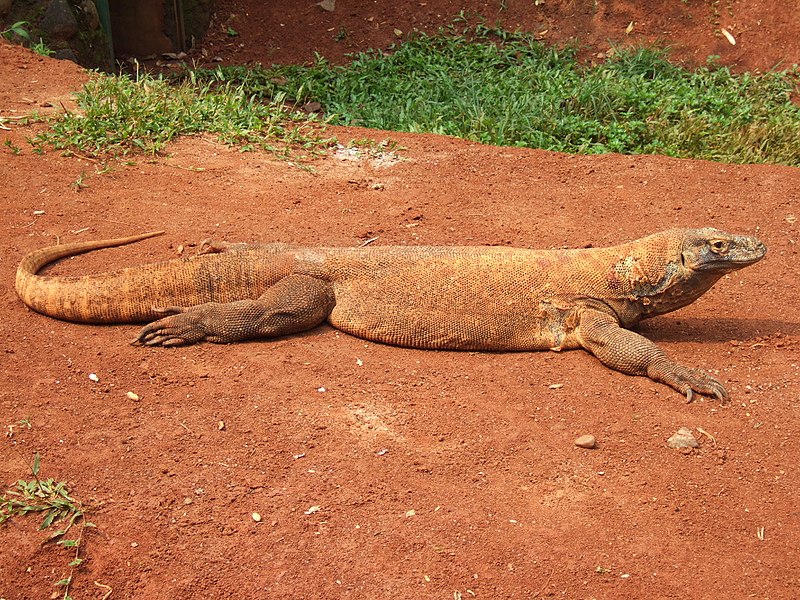
For such a rare animal, the Komodo dragon is quite well recognized. Also called the island monitor, the Komodo Dragon can grow to nearly 10 feet long and weigh up to 150lbs, making it the world’s largest living lizard.
Photo: Midori
The reason the Komodo dragon grows so large has been attributed to its island habitat. Komodo dragons can only be found on the Indonesian islands of Gili Motang, Gili Dasami, Rinca, Flores, and of course Komodo. Unlike mainland ecosystems, these islands have no large, native predatory mammals and it is believed that the Komodo dragon evolved into its large stature as a way to fill this niche.
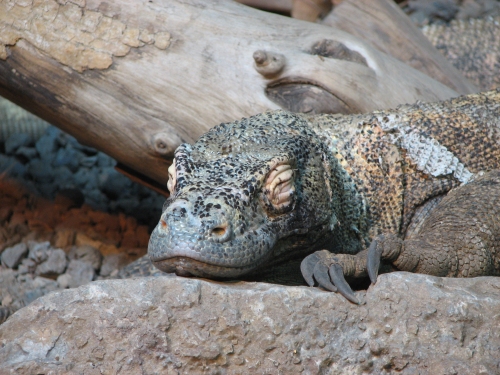
Komodo dragons are carnivores and mainly eat carrion; however they can and do hunt many varieties of animals up to the size of deer and goats. Komodo dragons eat up to 80% of their body weight at a time and have very slow metabolisms. Because of this, they can survive on as little as 12 meals per year; imagine eating just once a month!
Sleeping after a large meal.
Komodo dragons can live up to 30 years, but natural disasters, tourism, habitat loss and poaching of the animals they prey upon has led to a decline in their populations. It is estimated that there are fewer than 5000 Komodo dragons left in the wild, with only about 350 breeding females remaining.